
A Week Is Too Short for 0.001 BTC: Testing a New Scrypt Pool
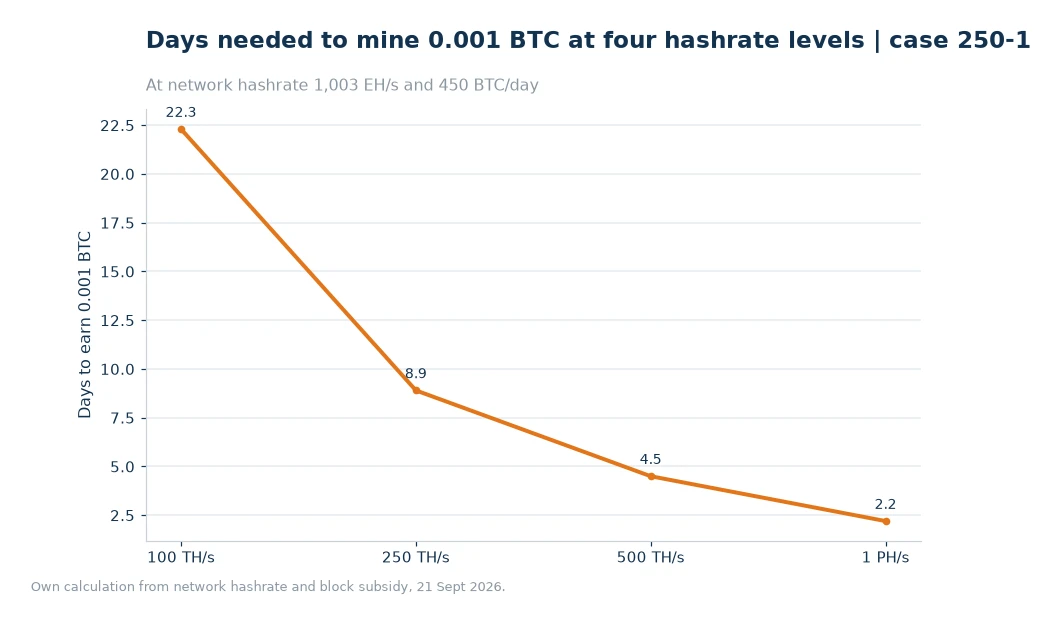
A seven-day trial feels like a fair test until the target is set. At 100 TH/s a 0.001 BTC checkpoint needs 22.3 days, at 250 TH/s 8.9, at 500 TH/s 4.5 and at 1 PH/s 2.2, on the 21 September 2026 network total. Within one week the smallest of those reaches only 31% of the checkpoint, so a switch has to be judged on rate and timing rather than on whether the milestone landed.
Key takeaways
- 0.001 BTC needs 22.3 days at 100 TH/s, longer than a typical trial window.
- A week at 500 TH/s crosses the checkpoint once and a half; at 100 TH/s it reaches 31%.
- Judge a new account on credited rate and payout timing, not on a milestone that cannot arrive yet.
- Check the merged mining line in the first statement, because a missing second stream is a setup issue.
The Trial Window and the Smallest Milestone
Switching pools is cheap to try and expensive to get wrong. The account is free, the configuration takes minutes and the hardware does not move, so the natural approach is to run for a week and compare. The problem is that a week is a very short slice of a mining schedule, and the round numbers people use as checkpoints are often larger than the slice.
0.001 BTC looks like the smallest sensible unit, and for a large operation it is. For a single Scrypt machine it is more than three weeks of output. A trial designed around it therefore cannot succeed or fail on schedule; it can only show whether the credits are arriving at the expected rate.
What a Week Can Actually Prove
Seven days can prove three things well. It can show that the worker connects and stays connected, that the pool credits the expected daily amount within a reasonable margin, and that payouts arrive on the schedule the pool describes. Those are the failure modes that matter in a migration, and all three are visible long before a coin milestone is reached.
What a week cannot prove is the long-run average, because variance dominates a short sample. A pool with unlucky block discovery can look weak for a week and be perfectly normal over a month. A pool that has just had a lucky run can look excellent for the same period and be unremarkable afterwards. A trial that ignores this will produce a confident and wrong conclusion, which is worse than no trial at all.
Set the Account Up Before the Switch
Before pointing hardware at a new pool, confirm the payout address, the worker name convention and the fee schedule. The ViaBTC LTC Mining Pool page shows the share accounting for the coins on offer, and the fee page names the listed rates so the first statement can be checked against them.
Write down the expected daily credit before the switch. Without that number, the first statement can only be read as "more or less than last time", which is not a comparison. With it, a 5% gap is a question and a 40% gap is a fault. The Profit Calculator will produce that expectation from the hash rate and the current network.
The fee schedule is the other half of the expectation. PPS+ and PPLNS produce different rhythms even when the average is similar, and a miner who moves between schemes without noticing will read normal variance as a problem.
Set the account up before the hardware moves, not after. Address mistakes are expensive to unwind because the coins do not come back, and a worker naming convention that differs from the machine labels makes every later reconciliation harder. Ten minutes of preparation protects the whole trial.
The Merged Mining Line
Scrypt pools commonly run merged mining, which means the account should show more than one coin. In the first statement, look for the second stream explicitly. If it is absent while the primary coin is credited normally, the likely cause is a configuration choice rather than a fault in the hardware.
This is worth checking in week one because the fix is trivial then and awkward later. A missing second stream for a quarter is not recoverable by configuration; the work was submitted, but the accounting was not set up to receive the companion coin.
Variance, Luck and the First Statement
Pool Luck is the figure that explains a week which does not match the calculation. On a PPLNS account the pool's block discovery feeds directly into the credit, so a short unlucky run shows up as a thinner statement. On PPS+ the block-reward portion settles hourly against current difficulty, which flattens that effect but carries a higher listed rate on the same slice.
Neither scheme is more honest than the other; they distribute different risks. The mistake is to compare a PPLNS week with a PPS+ month and conclude that one pool pays better. Compare like with like, over a period long enough for luck to average out.
A Decision Rule for Day Seven
On day seven, answer four questions. Did the reported hash rate match the machines? Was the credited amount within a few per cent of the written expectation? Did the payout arrive when the documentation said it would? Did the second coin appear? Three yeses and one fixable no is a reason to continue; two noes is a reason to investigate before committing more hardware.
The table shows how much of the 0.001 BTC checkpoint each hash rate reaches in a seven-day window, which is the reason the trial needs a different scorecard at the low end.
| Hash rate | BTC per day | Hours per 0.001 BTC | Reached in 7 days |
|---|---|---|---|
| 100 TH/s | 0.00004487 | 535 | 31% |
| 250 TH/s | 0.00011216 | 214 | 79% |
| 500 TH/s | 0.00022433 | 108 | 156% |
| 1 PH/s | 0.00044865 | 53 | 318% |
Worked example
The 100 TH/s trial, from daily rate to the share of the checkpoint reached.
- Daily issuance: 144 × 3.125 = 450 BTC.
- Per terahash: 450 ÷ 1,003,000,000 = 0.00000044865 BTC.
- At 100 TH/s: 0.00004487 BTC a day.
- Seven days: 7 × 0.00004487 = 0.00031406 BTC.
- Share of 0.001 BTC: 0.00031406 ÷ 0.001 = 31.4%.
- Hours per checkpoint: 0.001 ÷ (0.00004487 ÷ 24) = 535 hours, or 22.3 days.
- At 500 TH/s: 0.00022433 a day, so 7 days gives 0.00157031 BTC, which is 157% of the checkpoint.
- At 1 PH/s: 0.00044865 a day, so 7 days gives 0.00314057 BTC, or 314% — three crossings in one trial week.
Frequently asked questions
How long should a trial on a new pool last?
At least a week for connectivity and payout timing, and a full difficulty round or two for the average. One week is enough to catch setup errors but not enough to judge a PPLNS pool's long-run rate.
Why does my 100 TH/s machine reach only part of a 0.001 BTC checkpoint?
Because that checkpoint takes 22.3 days at 100 TH/s, while the trial lasts seven. The machine is working correctly if it credits 0.00004487 BTC a day; the milestone simply sits outside the window.
What should appear in the first merged-mining statement?
Two revenue lines from the same submitted work: the LTC reward and the companion DOGE stream. If only one appears, check the account configuration before assuming the pool or the hardware is at fault.
Score the Week on Rate and Timing
Give the trial a scorecard with those four questions and leave the milestone for later. A pool that credits the right rate, pays on time and reports both coins has passed, even if 0.001 BTC has not arrived. A pool that misses two of those has failed, however lucky the week looked.
After a month, revisit the checkpoint. By then the arithmetic has had time to show itself, and the decision can rest on a number rather than on an impression.
Trial figures rest on values read 21 Sept 2026 from the ViaBTC LTC pool, pricing and statistics pages[1]: 1,003 EH/s network hashrate, 3.125 BTC per block, 144 blocks daily, BTC $84,692. Published 24 Oct 2026; assumes continuous operation at the stated rate.