
Most fragrance supplier decisions are made with two instruments: a price sheet and an impression. Both are unreliable at volume, and neither survives a change of personnel. A weighted decision framework does not make the choice objective — it cannot, and pretending otherwise is a mistake — but it does force a buying team to state in advance what it will score, how much each criterion matters, and what evidence it will accept. That single act of agreement prevents most of the arguments that follow a signature.
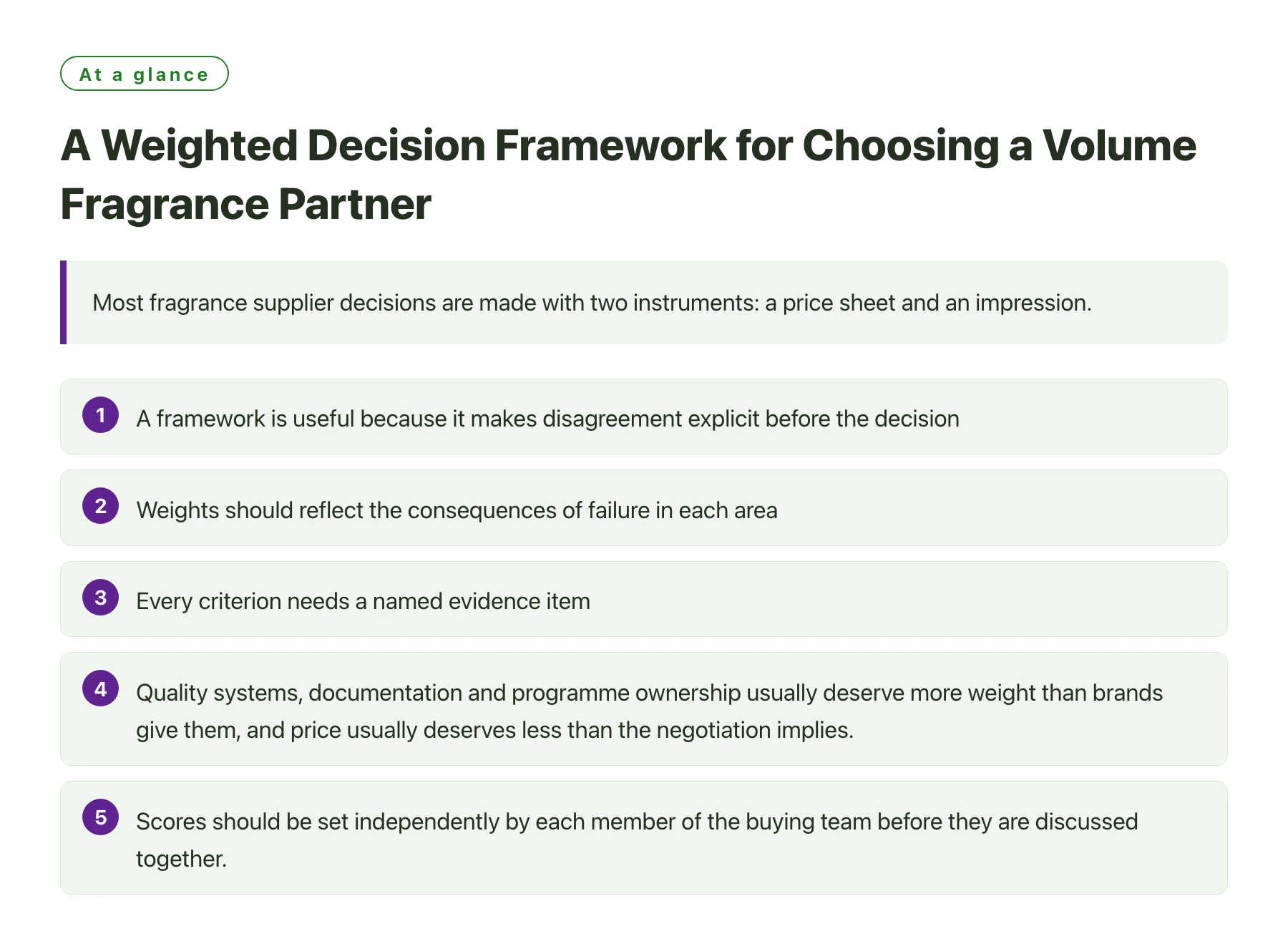
Key takeawaysA framework is useful because it makes disagreement explicit before the decision, not after it. · Weights should reflect the consequences of failure in each area, not the ease of measuring it. · Every criterion needs a named evidence item, because a score without evidence is an opinion with a number attached. · Quality systems, documentation and programme ownership usually deserve more weight than brands give them, and price usually deserves less than the negotiation implies. · Scores should be set independently by each member of the buying team before they are discussed together. · The framework's main output is not a winner but a short list of unresolved questions to put to the finalists.
Buying teams rarely disagree about the facts. They disagree about which facts matter, and that disagreement tends to surface at the worst possible moment, after a proposal has been circulated and positions have hardened. A weighted framework moves the argument to the beginning, where it is cheap.
This article sets out a structure that works for a fragrance programme large enough to require a committee decision. It deliberately includes a step that many scorecards omit: naming the evidence that would earn a score.
Agree the criteria before you see the proposals
The order of operations matters more than the arithmetic. Criteria and weights should be agreed before proposals are opened, because a scorecard written after the fact almost always bends toward the outcome someone already preferred. In practice, that means a short meeting to settle the list and the weights, and a written record of who agreed to what.
It also helps to separate criteria that are absolute from criteria that are comparative. Some things are not scored at all: a partner without the necessary documentation for your target market is not a low scorer, they are simply out of scope.
A framework has a second use that teams discover later. When the same criteria are applied to a partner two years into a relationship, it becomes a review tool rather than a selection tool, and a much more honest one than a general conversation about satisfaction.
Six criteria, their weights and the evidence each one needs
| Criterion | What you are actually scoring | Suggested weight | Evidence to demand |
|---|---|---|---|
| Comparable experience | Whether the partner has run this kind of product, market and volume before | 15% | A named comparable project type and the stages handled in house |
| Technical control | How the formula, the process and the reference standard are kept consistent | 20% | Process specification structure, batch record sample, reference retention rule |
| Documentation and compliance | Whether the required documents exist, who produces them and when | 20% | A document list by market with a named provider for each item |
| Programme ownership | Who inside the supplier is accountable, and how escalations work | 15% | A named owner, a technical contact and a described escalation path |
| Cost structure | Total landed cost including packaging, decoration, assembly and freight | 20% | A separated quote with each cost line visible and comparable |
| Reversibility | How easily the programme can move, pause or change later | 10% | Tooling ownership, exit process and availability of standard components |
Treat the weights as a starting position, not a formula. The important property of the table is the fourth column: if a criterion cannot be tied to something a supplier could hand over, it probably belongs in the comments rather than in the score.
Running the scoring without pretending it is scientific
The mechanics are deliberately simple. Each member of the buying team scores each finalist against each criterion on a small scale, independently. Scores are then compared, and the discussion is confined to the largest disagreements rather than to the average. Those disagreements are where the real information is: one person saw something in a factory visit, another read a document more carefully.
It is worth resisting the temptation to refine the weights until they produce a preferred result. If two suppliers finish within a few points, the framework has done its job by showing you which questions remain open. The decision then rests on judgement, which is where it belongs.
One criterion deserves a longer conversation than its weight suggests. Quality control is not a department that can be assessed from a certificate list; it is a set of habits visible in how a partner talks about deviations and how it documents them. Published material from the industry association on safe use and fragrance science is a useful reference point for how the sector frames those responsibilities [1], and it makes a better basis for questioning than a general request for reassurance.
The same applies to verification of claims. A structured approach to due diligence beats an unstructured one precisely because it produces comparable evidence for each supplier, and the structure used on due diligence on a perfume manufacturer is a reasonable template for a volume programme.
Score the partner, not the salesperson
Sales relationships are real and worth something, but they are not durable. A framework that scores a named programme owner, a technical team and a documented process is scoring the organisation. This matters most when a brand is choosing between two suppliers whose commercial offers look similar.
Before the final decision, ask each finalist for one thing that is not in the proposal: a written answer to the question the framework could not settle. It might be how they would handle a decoration failure detected at ninety percent of the run, or what happens if a material is discontinued mid-season. The quality of that answer, and how quickly it arrives, is usually more informative than the score themselves.
The two criteria teams consistently under-weight
Documentation and reversibility are the criteria most often discounted during selection and most often missed afterwards. Documentation looks like administration until a retailer or a customs authority asks a specific question. The reports that back a compliance claim usually come from accredited laboratory work — stability, packaging compatibility, microbiological quality — and a buying team should establish in advance which of those reports will be produced for its product and which will not [2]. Reversibility looks theoretical until a line is discontinued, a design changes or a relationship ends.
Both are visible before the decision if you ask for them directly. A manufacturer that keeps its service scope and its standards current, in the way that a house like Xuelei fragrance house maintains a public description of what it does, is easier to assess than one whose capability exists only in conversations — but the public description is a starting point for questions, not a substitute for the documents.
Similarly, the way a partner presents what it has already done is a fair subject for scrutiny. It is worth reading Xuelei case studies the way you would read a supplier's own audit evidence: not to admire the projects, but to check whether each example names a product type, a stage handled and a problem solved. Where a case study contains none of those, it is marketing rather than evidence, and that distinction is worth carrying into the score.
Sources
- IFRA: Safe Use and Fragrance Science —— IFRA's explanation of how fragrance materials are scientifically assessed for safe use and how those conclusions are applied by the industry.
- SGS: Cosmetics, Personal Care & Household Testing —— Testing, inspection and certification services for cosmetics and personal care, including microbiological, stability and safety testing aligned with cosmetics GMP.
Frequently asked questions
How many fragrance suppliers should a volume programme shortlist?
Three is usually enough to compare, and more than four rarely adds information because each additional partner consumes review time without adding a new kind of evidence. The value comes from applying the same criteria and the same questions to each one.
Should price be included in a supplier scorecard?
Yes, but only as a comparable figure. That means normalising the scope first — compound, container, closure, decoration, assembly, testing and freight separated into lines — so that the cost criterion measures total landed cost rather than the smallest number on a page.
How do we score quality when suppliers all claim to have strong quality control?
Ask for structure rather than assurance: how the process specification is written, how a batch record is completed, who performs the comparison against the reference, and what happens when a check fails. Comparable answers can be scored; promises cannot.
What if the weighted scores produce a tie?
A tie usually means two suppliers are genuinely comparable, and the remaining difference is in judgement and working style. Treat it as a signal to run one more sample round or a factory visit with both finalists, rather than as a reason to keep adjusting the weights.
Can the same framework be used for annual supplier reviews?
It can, and it is more useful in that role than a general discussion. Keeping the criteria stable lets a brand see whether a partner is improving in the areas that matter or drifting in the ones that were hardest to fix.