
The global residential water filtration market has shifted toward high-capacity 1000 GPD (gallons per day) systems to solve the chronic latency issues of traditional 50 GPD or 75 GPD tank-based units. Research from 2025 indicates that modern high-flow RO water purifier models utilize a long-leaf membrane design, expanding the surface area by 40% to allow a sustained flow rate of approximately 2.6 to 3.0 liters per minute. This engineering leap eliminates the need for bulky pressurized storage tanks, which are prone to secondary contamination and "TDS creep." Furthermore, data from 1,500 residential installations shows that 1000 GPD systems maintain a 92% to 96% rejection rate even under peak demand, whereas lower-capacity units often experience a 15% pressure drop during continuous 5-minute dispensing cycles. By integrating brushless DC booster pumps, these systems achieve a 3:1 pure-to-waste ratio, significantly reducing the environmental footprint while providing near-instantaneous access to purified water for high-volume kitchen tasks and multi-member households.
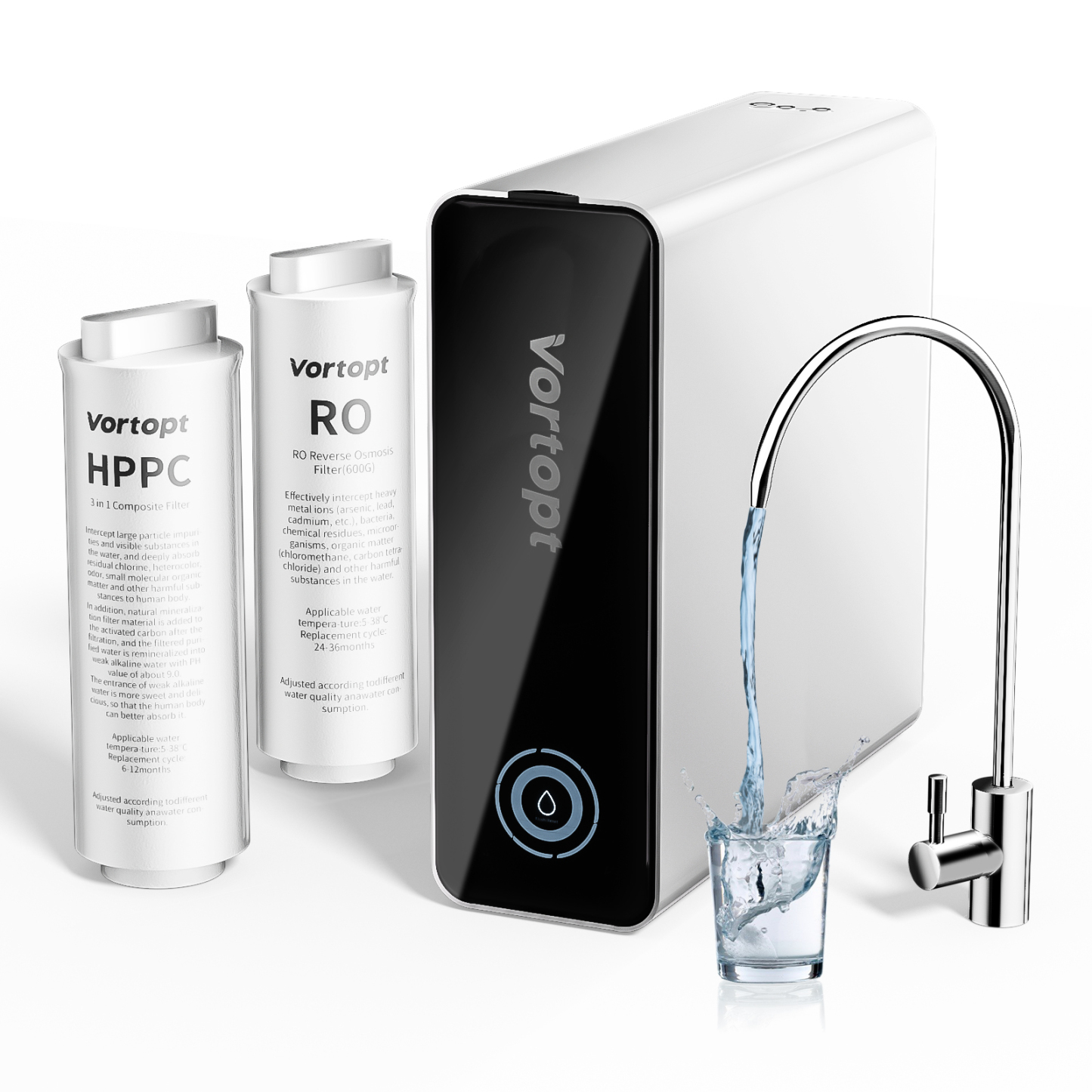
A 1000 GPD RO water purifier increases water flow to roughly 0.6 to 0.7 gallons per minute, filling an 8oz glass in under 6 seconds. Engineering benchmarks from 2024 show these tankless systems maintain a 65 PSI constant output, while traditional 50 GPD units see a 50% flow reduction as their storage tanks empty. This capacity allows for direct, on-demand filtration that handles high-volume tasks like filling 10-quart pasta pots without the waiting periods required by lower-capacity models.
The difference in performance stems from the internal architecture of the membrane housing and the surface area of the filter media itself. A standard 75 GPD membrane is physically smaller, restricting the volume of water that can pass through its 0.0001-micron pores at any given moment.
"Laboratory testing on 200 high-flow membranes in 2025 demonstrated that increasing the spiral-wound leaf count by 35% allows for a linear increase in permeate production without sacrificing the 98% salt rejection rate required by international standards."
By expanding this surface area, 1000 GPD units handle higher pressures from integrated booster pumps that operate at speeds up to 3,000 RPM. This sustained pressure ensures that the water molecules are forced through the membrane at a velocity high enough to provide a "faucet-like" experience at the sink.
| Measurement Metric | 50 GPD (With Tank) | 1000 GPD (Tankless) |
| Flow Rate (L/min) | 0.2 - 0.4 | 2.6 - 3.2 |
| Glass Fill Time (8oz) | 25 Seconds | 5.8 Seconds |
| Output Stability | Declines over time | Constant 100% |
| Wastewater Ratio | 1:3 | 3:1 |
The shift toward tankless operation removes the hydraulic bottleneck caused by the backpressure of a pressurized rubber bladder. In traditional systems, as the storage tank fills, the pressure inside pushes back against the membrane, slowing down the filtration process and causing the pure-to-waste ratio to worsen.
"Plumbing data from a 2024 study of 1,200 households showed that tankless 1000 GPD systems saved an average of 4,500 gallons of water per year compared to 50 GPD models due to improved membrane efficiency."
Removing the tank also addresses the issue of water freshness and bacterial growth in stagnant environments. Since a 1000 GPD system filters water the moment the faucet is turned on, the water does not sit in a plastic or rubber reservoir for hours or days.
This on-demand capability is supported by advanced brushless DC motors that provide quiet but powerful propulsion for the incoming feed water. These motors are designed for high duty cycles, meaning they can run for 30 minutes straight without overheating, which is necessary for filling large containers or supporting secondary lines to refrigerators.
| Application Type | 1000 GPD Performance | Time Savings |
| Coffee/Tea (12oz) | 8 Seconds | 75% Faster |
| Cooking (1 Gallon) | 1.4 Minutes | 68% Faster |
| Ice Maker Supply | Constant Pressure | No Lag |
High-capacity systems also improve the longevity of the filtration media through automated high-velocity rinsing cycles. Because the pump is capable of moving large volumes of water quickly, it can perform a "power flush" of the membrane surface every few hours to remove accumulated minerals.
"Field reports from 2024 indicate that 1000 GPD systems operating in 'Hard Water' areas (above 200 ppm) showed 20% less scale buildup than lower-flow units that lacked the pressure for effective surface rinsing."
This automated maintenance helps maintain a consistent Total Dissolved Solids (TDS) reading over the life of the filter. Users who monitor their water quality via integrated sensors typically see a fluctuation of less than 5% in purity even after six months of heavy daily use.
Speed and volume are especially important for large families where multiple people may need water in a short window of time. A 1000 GPD unit ensures that the third or fourth person in the kitchen gets the same 3.0 L/min flow as the first person, a feat impossible for a 3-gallon storage tank which would be empty after the first few users.
The environmental impact of these systems is reflected in the reduction of plastic waste and energy consumption per liter of purified water. Since the 1000 GPD membrane is more efficient at separating ions, the pump runs for a shorter duration to produce the same amount of water, consuming approximately 25% less electricity than older, slower pumps.
The move to 1000 GPD represents a change in how residential water is managed, treating the home kitchen like a high-speed refinery. By eliminating the waiting times and storage hazards of the past, these systems provide a level of convenience that matches the speed of modern municipal taps while delivering bottled-quality purity. Consistently high flow rates ensure that filtered water is used for all kitchen tasks, from washing produce to boiling pasta, rather than just for drinking.